

Article
How to Identify Original Imported Branded Shirts — 10 Ways to Spot Fake vs Real
Pakistan’s market is flooded with fake and replica branded shirts. Walk through any local clothing market in Rawalpindi, Lahore, or Karachi and you will find shirts carrying labels of Gap, Ralph Lauren, Tommy Hilfiger, and Abercrombie — selling for Rs. 400 to Rs. 800. They look convincing at a glance. The logo seems right. The tag is there. But they are not original.
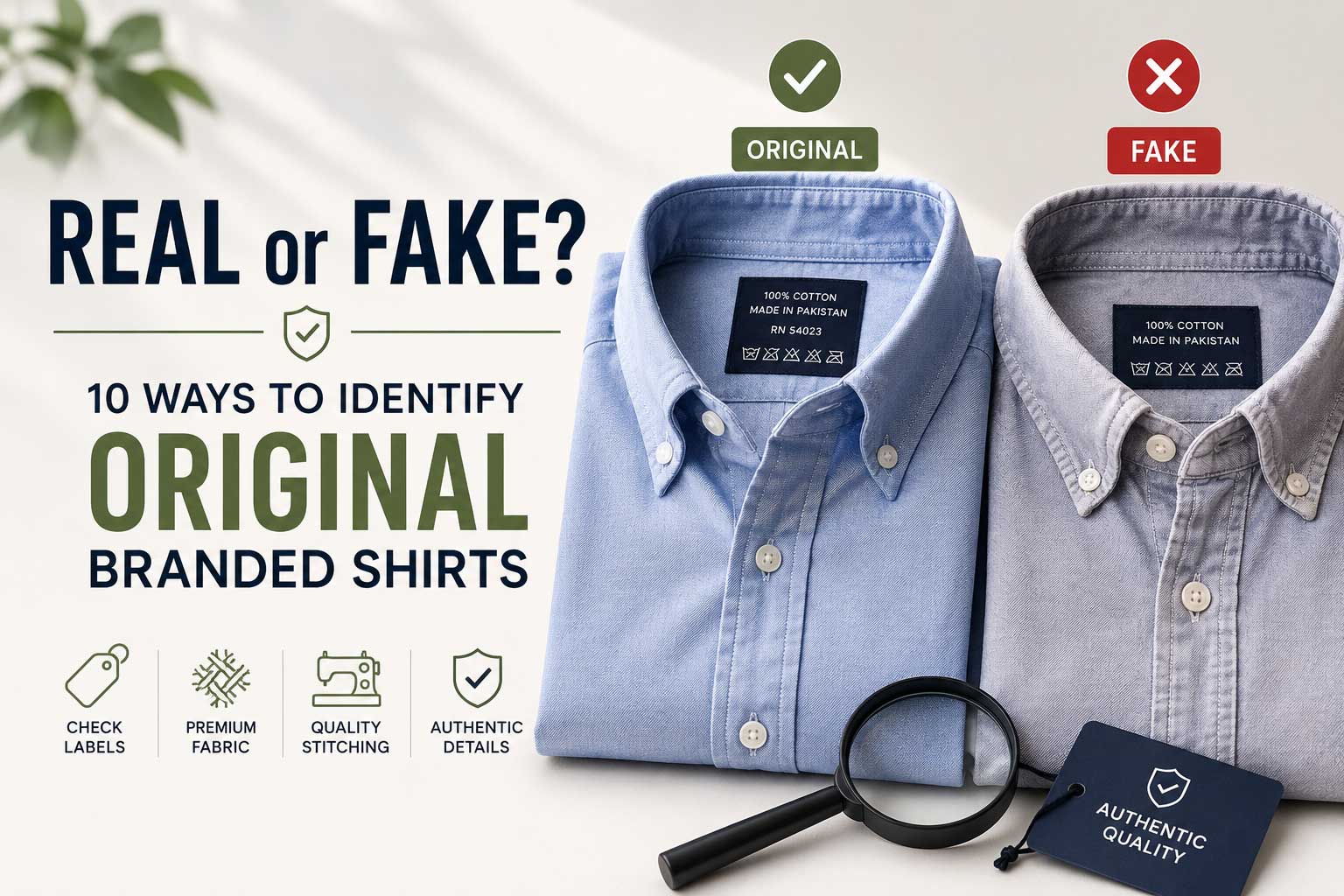
The question Pakistani buyers ask more than any other is: how do I know if a branded shirt is real or fake?
In this guide we give you 10 practical, reliable ways to identify a 100% original imported branded shirt — no matter where you are buying from.
Why Does It Matter?
Buying a fake branded shirt is not just a waste of money. It means:
- Poor quality fabric that fades, shrinks, or tears within months
- Unregulated dyes that can cause skin irritation or allergies
- Stitching that comes apart after a few washes
- You pay a brand price but get a replica quality
- You feel cheated — and rightly so
Knowing how to spot an original protects your money and ensures you actually get what you paid for.
Way 1 — Check the Care Label Inside the Shirt
The care label — sewn inside the collar or side seam — is one of the most reliable indicators of authenticity. Original imported branded shirts always have a care label that includes:
- Fabric composition: Example — 100% Cotton or 60% Cotton 40% Polyester
- Washing instructions using international care symbols
- Country of manufacture: Made in Pakistan, Made in Bangladesh, Made in Vietnam etc.
- RN number or CA number — a registration number required by US and Canadian law for all garments sold in North America
Fake shirts either have no care label, a poorly printed one, or a label with incorrect washing symbols. On an original shirt the care label is always neatly stitched — never glued or loosely attached. The text is clear, properly aligned, and uses correct spelling throughout.
Pakistan-specific tip: Finding “Made in Pakistan” on an imported branded shirt is actually a very good sign — not a bad one. As we explained in our previous blog post, brands like Gap, Levi’s, Nike, and Ralph Lauren all manufacture in Pakistan. A “Made in Pakistan” label on a genuine Gap or Old Navy shirt is 100% normal and authentic.
Way 2 — Examine the Brand Label at the Collar
Every original imported branded shirt has a brand label sewn at the back of the collar. This label tells you more than you might think:
- Font and spacing: The brand name font on an original label is always precise, consistent, and correctly spaced. Fake labels often have slightly off fonts, uneven letter spacing, or incorrect kerning
- Label material: Original brand labels are made from high-quality woven fabric or premium printed material. Fake labels feel cheap, thin, or have a slightly different texture
- Spelling: Check every letter. Counterfeiters sometimes make subtle spelling errors — “Raiph Lauren” instead of “Ralph Lauren” or “Abrecrombie” instead of “Abercrombie”
- Stitching on the label: On an original shirt the brand label is perfectly and evenly stitched on all four sides. On a fake the stitching is often uneven, loose, or missing on one side
- Logo accuracy: The polo player on Ralph Lauren, the moose on Abercrombie, the flag on Tommy Hilfiger — each brand has specific logo details that fakes get slightly wrong. Study the official logo and compare carefully
Way 3 — Feel the Fabric Quality
Original branded shirts use premium quality fabrics that feel noticeably different from fake replicas. This is one of the easiest ways to tell the difference once you have felt both:
- Original cotton: Feels soft, smooth, breathable, and has a natural weight. It does not feel stiff or scratchy
- Fake cotton: Often feels rough, too stiff, slightly shiny, or artificially smooth due to chemical treatments
- Weight test: Hold the shirt and feel its weight. Original branded shirts use a consistent fabric weight appropriate for the garment type. Fake shirts often feel unusually light or flimsy
- Stretch test: Gently stretch a small section of the fabric and release. Original quality fabric springs back to its original shape immediately. Fake fabric either does not stretch properly or does not recover well
- Transparency test: Hold the shirt up to light. Original shirts have a consistent, even weave. Fake shirts often show uneven weaving or thin patches where the fabric quality is inconsistent
Way 4 — Inspect the Stitching Quality
Stitching quality is one of the most reliable and easiest ways to identify an original branded shirt. Original imported brands invest in precise, high-quality stitching that fakes simply cannot replicate at low cost.
- Stitch density: Original branded shirts typically have 10 to 12 stitches per inch — tight, even, and consistent throughout the garment
- Straight seams: All seams on an original shirt run perfectly straight. Fake shirts often have slightly curved or wavy seams especially at the collar and cuffs
- No loose threads: Original shirts have zero loose or hanging threads anywhere. Fake shirts almost always have loose threads at seam ends, button holes, or collar joins
- Interior finishing: Flip the shirt inside out and examine the interior seams. Original shirts have clean, finished interior seams — often with neat overlocking. Fake shirts leave raw, unfinished edges inside
- Collar stitching: The collar of an original shirt is perfectly symmetrical, evenly stitched, and lies flat. A fake collar often has uneven stitching or does not sit flat properly
- Pattern matching at seams: On checked or striped shirts, the pattern should align perfectly at the side seams and pocket joins. Original shirts always match patterns at seams. Fake shirts almost never do
Way 5 — Check the Buttons and Zippers
Buttons and zippers are details that counterfeiters often overlook — making them excellent authenticity indicators:
- Button material: Original branded shirts use buttons made from horn, corozo nut, or high-grade resin. They feel solid, have a slight sheen, and produce a clear sound when tapped. Fake buttons are usually lightweight plastic with a dull finish
- Button holes: On an original shirt, button holes are perfectly sized, neatly finished, and evenly spaced. Fake button holes are often slightly frayed, uneven, or inconsistently sized
- Button attachment: Original shirt buttons are attached with a thread shank — a small thread loop underneath — that prevents the button from pulling the fabric when buttoned. Fake buttons are usually sewn directly flat with fewer thread passes
- Zipper brand: Many original branded shirts and pants use YKK zippers — the world’s most trusted zipper brand. Check the zipper pull for the YKK logo. Fake garments often use unbranded, cheap zippers that stick or feel rough
- Zipper movement: Pull the zipper up and down. On an original garment it glides smoothly without resistance. A sticky or rough zipper is a strong indicator of a fake
Way 6 — Look for the RN Number or Style Number
This is a verification method most Pakistani buyers do not know about — but it is extremely powerful.
All garments legally sold in the United States must carry an RN number (Registered Number) or WPL number issued by the US Federal Trade Commission. This number appears on the care label and identifies the exact manufacturer.
- Find the RN number on the care label — it looks like “RN# 54023” or similar
- Go to the US FTC website: rn.ftc.gov
- Enter the RN number
- The website will show you exactly which brand that number belongs to
- If the number does not exist or belongs to a different brand — the shirt is fake
This single check can confirm or deny authenticity in under one minute. Fake shirts either have no RN number or use a made-up number that does not exist in the FTC database.
Way 7 — Examine the Size Tag and Fit Consistency
Original branded shirts have precise, consistent sizing that is maintained across every garment of the same size. This consistency comes from professional pattern-making and quality control systems that fake manufacturers simply do not invest in.
- Size label quality: The size label on an original shirt is clearly printed or woven, properly attached, and correctly spelled. Fake size labels are often poorly printed, slightly faded, or have incorrect sizing information
- Actual measurements: An original Medium shirt from Gap or Ralph Lauren will have consistent measurements — chest, shoulder, length, sleeve — matching the brand’s official size chart. A fake shirt claiming to be Medium may measure like a Small or Large
- Fit symmetry: Hold the shirt by the collar and let it hang. Both sides should be perfectly symmetrical. Fake shirts often have one side slightly longer or one shoulder slightly wider due to poor cutting and pattern-making
- Hem alignment: The hem of an original shirt is perfectly even all the way around. Fake shirts often have an uneven hem — slightly higher on one side than the other
Way 8 — Smell the Shirt
This sounds unusual but it is a genuinely reliable test that experienced pre-loved buyers use regularly:
- Original imported shirts: Smell of clean fabric, sometimes with a faint detergent smell if previously washed, or a neutral fabric smell if new. They do not have a strong chemical odor
- Fake replica shirts: Often have a strong chemical smell — from unregulated dyes, cheap fabric treatments, or poor-quality finishing chemicals. This smell is difficult to wash out even after multiple washes
- Why this matters: Unregulated dyes and chemical treatments used in fake garments can cause skin reactions, allergies, and rashes — especially for people with sensitive skin
If a shirt smells strongly of chemicals, plastic, or artificial fragrance — walk away. An original shirt should smell clean and neutral.
Way 9 — Check the Price — Real vs Too Good to Be True
Price is not always a reliable indicator on its own — but combined with other checks it tells a clear story:
- New branded shirts in Pakistan: An original new Ralph Lauren polo in Pakistan would cost Rs. 8,000 to Rs. 15,000 minimum if sold through official channels
- Suspiciously cheap “branded” shirts: If someone is selling a “Ralph Lauren” shirt for Rs. 500 to Rs. 800 — it is almost certainly fake. Original fabric, buttons, stitching, and brand licensing simply cannot be produced at that price
- Pre-loved pricing: Genuine pre-loved imported branded shirts — worn once or twice by their original owners — are priced reasonably below retail. At Faroshgah our shirts start from Rs. 1,499 — which reflects the real cost of authentic imported garments
- The rule: If the price is 80 to 90% below what the brand charges internationally — it is not a deal. It is a fake
Way 10 — Buy from a Trusted and Transparent Source
Ultimately the single most reliable way to ensure you are buying an original imported branded shirt is to buy from a seller who is transparent, consistent, and accountable:
- Shows real product photos: Multiple angles, close-ups of labels, stitching details, and care tags — not stock photos
- Shares care label photos: A genuine seller will always show the care label and brand label clearly in product photos
- Provides measurements: Original pre-loved sellers provide actual measurements — chest, shoulder, length, sleeve — not just S/M/L/XL
- Has a clear return policy: A seller confident in their product’s authenticity will offer a return if the item is not as described
- Has verifiable reviews: Real customer feedback — not generic five star ratings with no text
- Responds to questions: Ask about the brand, the RN number, the fabric composition. A genuine seller will answer confidently and accurately
Quick Reference Checklist
- ✅ Care label present with RN number, fabric composition, and country of origin
- ✅ Brand label correctly spelled with accurate logo and even stitching
- ✅ Fabric feels soft, has consistent weight, and springs back when stretched
- ✅ Stitching is tight, even, and straight with no loose threads
- ✅ Buttons are solid, evenly spaced, and neatly finished
- ✅ RN number verified on rn.ftc.gov matches the brand
- ✅ Size is consistent and shirt hangs symmetrically
- ✅ Shirt smells clean with no strong chemical odor
- ✅ Price is reasonable — not suspiciously cheap
- ✅ Seller is transparent with real photos and measurements
Where to Buy 100% Original Imported Branded Shirts in Pakistan
At Faroshgah every single shirt is 100% original imported branded — not fake, not replica. Here is how we guarantee it:
- ✅ Every shirt shows clear photos of the brand label and care label
- ✅ Fabric composition and country of manufacture listed for every product
- ✅ Actual measurements provided — chest, shoulder, length, sleeve
- ✅ Condition described honestly — Premium, Excellent, or Very Good
- ✅ Shirts starting from Rs. 1,499 only
- ✅ Free Delivery Nationwide
- ✅ Cash on Delivery Available
- ✅ 7-day return if item is not as described
👉 Browse Our 100% Original Imported Branded Shirts at Faroshgah
Final Thoughts
Spotting a fake branded shirt is a skill — and now you have it. The care label, the RN number, the stitching quality, the fabric feel, the buttons, and the price — together these ten checks give you everything you need to confidently identify an original imported branded shirt from a fake replica.
The pre-loved market in Pakistan is full of genuine original shirts at fair prices — you just need to know what to look for and who to trust.
Found this guide helpful? Share it with friends who love branded clothing and want to shop smart. Visit Faroshgah for Pakistan’s most trusted collection of 100% original imported pre-loved branded shirts — delivered free to your doorstep anywhere in Pakistan.
